



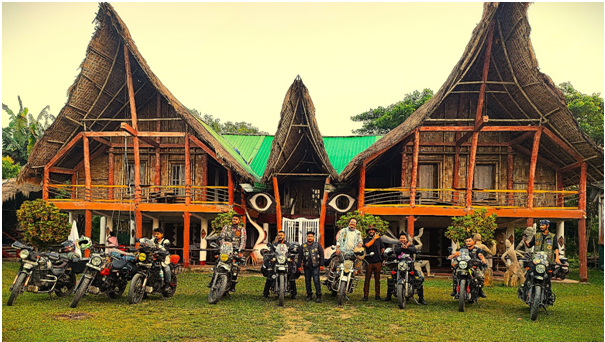
Have you ever wondered why some men ride bikes into long, unknown roads for days—with no plan, no itinerary, sometimes not even a destination? What keeps them going?
I ride too. For me, it was simple. It was fun. I liked riding long distances—it cleared my head, decluttered my thoughts. But then I started noticing others. Men who rode for hours. For days. Sometimes for months.
I began to wonder—why?
I used to think people who ride like that are either running from something, or running toward something.
During my solo rides through UP, Haryana, Uttarakhand, Rajasthan and Himachal, I met many riders along the way. I rode with them for days, shared routes, stopped at the same places, and slowly got to know them. Most of them were kind and helpful. They guided me on routes, suggested places, and made the journey easier. Many were new riders, and riding in groups made them feel safer—which made sense.
But I kept asking the same question: why do you ride like this?
Everyone had a different answer.
I met a guy from Bangalore in Rishikesh. He had ridden all the way there and from there his plan was to go to Leh, then Dhanush Kodi, and back to Bangalore. He had a specific distance target in mind, something he was chasing. He was recording the entire journey with cameras mounted on his helmet and bike. Another rider I met in Rudraprayag just wanted to visit a few places he had always thought about. Some told me it was on their to do list or dream to ride in the mountains—to feel the air, to see the landscape in a way you can’t from inside a car. Some wanted a break from their desk jobs. Just a week away from routine.
Some wanted good pictures—to look cool on social media. Some were trying to build a YouTube channel, hoping to become influencers. For some, it was a challenge—to prove they could ride through the mountains.
Some were riding with their sons and daughters, trying to spend time with them, reconnecting now that they were older. And for a few, it was simply the cheapest and most flexible way to travel—to reach places that are otherwise hard to get to. Everyone had a reason.
But somehow, none of those answers felt complete.On my journey to Assam, specifically to Majuli Island. I was sitting outside a small tea café by the banks of the Brahmaputra, waiting for the ferry.That’s when I first saw them.A group of bikers sat inside the café, talking loudly about routes, rides, and the road to Majuli. They were all wearing leather jackets covered in patches—club names, slogans, flags. There was something about them that stood out.
I was sitting outside, eating peanuts, when one of them stepped out for a smoke. For no particular reason, I said, “You guys are a very cool biker group.”He smiled.“We’re not just a group—we’re a club.”
Then he showed me the patch on his vest—Royal Jaguars.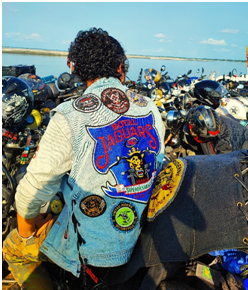

“I started this club,” he added, with a kind of pride. I asked his name. “Manas Dutta.”
We spoke for a few minutes. He asked where I was headed and what my plan was. Then he casually mentioned that I needed to buy a ticket for the ferry (I had assumed you could just get on and pay there). He pointed me toward the ticket counter and showed me the way.
Later, on the ferry, it was afternoon. The place was packed—no seats inside, and the heat made it worse. Outside wasn’t much better.
A few people standing nearby started talking about the sun.
“It feels like we’re getting roasted,” one of them said.
“Yeah,” I replied, “roasted chicken… except we’re the chicken.”
They laughed.
Well, I am from the UP and I have survived places like Bhiwadi, one of the hottest districts in India. And with my Indiana Jones hat on, I felt confident I could survive this too.
So I stayed outside. At least I could enjoy the view, the wide Brahmaputra, the forests in the distance, the open sky.


That’s when I saw them again.
Up on the top deck—bikes lined up, voices rising, laughter carried by the wind.
I was taking pictures when Manas spotted me and waved me over.
They greeted me like we’d known each other for a while.
They liked my hat, and I ended up telling them the story behind it. I was munching on peanuts again when Manas smiled and said, “You really like eating Badam (peanut), don’t you?”
“It’s one of my favourite snacks,” I replied.
They laughed.
That’s when I saw them again.
Up on the top deck—bikes lined up, voices rising, laughter carried by the wind.
I was taking pictures when Manas spotted me and waved me over.
They greeted me like we’d known each other for a while.
They liked my hat, and I ended up telling them the story behind it. I was munching on peanuts again when Manas smiled and said, “You really like eating Badam (peanut), don’t you?”
“It’s one of my favourite snacks,” I replied.
They laughed.
Then they started sharing more about their journeys—where they had come from, where they were heading, about their clubs, and even the meaning behind each patch on their jackets. I got to know them.


Rehman, was quite the singer of the group. He started singing, and soon everyone joined in.
That’s when I also got to know how big an influence Zubeen Garg is on Assamese people especially in youngsters.


Time felt different there. You don’t really notice it passing when you’re caught up in a moment like that.
Before I knew it, we had reached Majuli.
I stepped off the ferry while they got busy unloading their bikes. Rehman told me to wait for them downstairs.
As I stood there, the same guys I had spoken to earlier about the heat came up to me and asked if I needed a ride.
I told them I was waiting for the bikers, pointing in their direction.
We shook hands, and they went on their way.
A few minutes later, the bikers came down. We took a picture together and said our goodbyes.


