
Between Silence and the Throttle
Why some riders keep coming back to the road
Have you ever wondered why some men ride bikes into long, unknown roads for days—with no plan, no itinerary, sometimes not even a destination? What keeps them going?
I ride too. For me, it was simple. It was fun. I liked riding long distances—it cleared my head, decluttered my thoughts. But then I started noticing others. Men who rode for hours. For days. Sometimes for months.
I began to wonder—why?
I used to think people who ride like that are either running from something, or running toward something.
During my solo rides through UP, Haryana, Uttarakhand, Rajasthan and Himachal, I met many riders along the way. I rode with them for days, shared routes, stopped at the same places, and slowly got to know them. Most of them were kind and helpful. They guided me on routes, suggested places, and made the journey easier. Many were new riders, and riding in groups made them feel safer—which made sense.
But I kept asking the same question: why do you ride like this?
Everyone had a different answer.
I met a guy from Bangalore in Rishikesh. He had ridden all the way there and from there his plan was to go to Leh, then Dhanush Kodi, and back to Bangalore. He had a specific distance target in mind, something he was chasing. He was recording the entire journey with cameras mounted on his helmet and bike. Another rider I met in Rudraprayag just wanted to visit a few places he had always thought about. Some told me it was on their to do list or dream to ride in the mountains—to feel the air, to see the landscape in a way you can’t from inside a car. Some wanted a break from their desk jobs. Just a week away from routine.
Some wanted good pictures—to look cool on social media. Some were trying to build a YouTube channel, hoping to become influencers. For some, it was a challenge—to prove they could ride through the mountains.
Some were riding with their sons and daughters, trying to spend time with them, reconnecting now that they were older. And for a few, it was simply the cheapest and most flexible way to travel—to reach places that are otherwise hard to get to.
Everyone had a reason.
But somehow, none of those answers felt complete.
On my journey to Assam, specifically to Majuli Island. I was sitting outside a small tea café by the banks of the Brahmaputra, waiting for the ferry.
That’s when I first saw them.
A group of bikers sat inside the café, talking loudly about routes, rides, and the road to Majuli. They were all wearing leather jackets covered in patches—club names, slogans, flags. There was something about them that stood out.
I was sitting outside, eating peanuts, when one of them stepped out for a smoke.
For no particular reason, I said, “You guys are a very cool biker group.”
He smiled.
“We’re not just a group—we’re a club.”
Then he showed me the patch on his vest—Royal Jaguars.
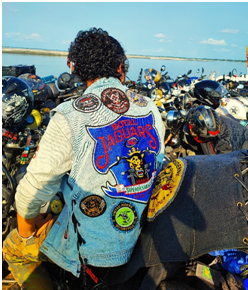
“I started this club,” he added, with a kind of pride.
I asked his name.
“Manas Dutta.”
We spoke for a few minutes. He asked where I was headed and what my plan was. Then he casually mentioned that I needed to buy a ticket for the ferry (I had assumed you could just get on and pay there). He pointed me toward the ticket counter and showed me the way.
Later, on the ferry, it was afternoon. The place was packed—no seats inside, and the heat made it worse. Outside wasn’t much better.
A few people standing nearby started talking about the sun.
“It feels like we’re getting roasted,” one of them said.
“Yeah,” I replied, “roasted chicken… except we’re the chicken.”
They laughed.
Well, I am from the UP and I have survived places like Bhiwadi, one of the hottest districts in India. And with my Indiana Jones hat on, I felt confident I could survive this too.
So I stayed outside. At least I could enjoy the view, the wide Brahmaputra, the forests in the distance, the open sky.

That’s when I saw them again.
Up on the top deck—bikes lined up, voices rising, laughter carried by the wind.
I was taking pictures when Manas spotted me and waved me over.
They greeted me like we’d known each other for a while.
They liked my hat, and I ended up telling them the story behind it. I was munching on peanuts again when Manas smiled and said, “You really like eating Badam (peanut), don’t you?”
“It’s one of my favourite snacks,” I replied.
They laughed.
Then they started sharing more about their journeys—where they had come from, where they were heading, about their clubs, and even the meaning behind each patch on their jackets. I got to know them little.
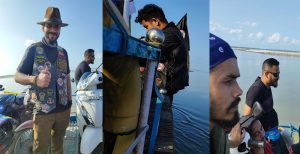
Jaggu, was quite the singer of the group. He started singing, and soon everyone joined in.
That’s when I also got to know how big an influence Zubeen Garg is on Assamese people especially in youngsters.
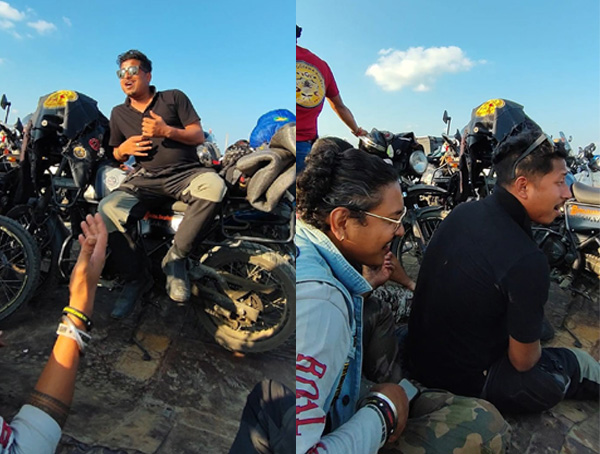
Time felt different there. You don’t really notice it passing when you’re caught up in a moment like that.
Before I knew it, we had reached Majuli.
I stepped off the ferry while they got busy unloading their bikes. Jaggu told me to wait for them downstairs.
As I stood there, the same guys I had spoken to earlier about the heat came up to me and asked if I needed a ride.
I told them I was waiting for the bikers, pointing in their direction.
We shook hands, and they went on their way.
A few minutes later, the bikers came down. That’s when I noticed something—Manas had a large knife, almost like a machete, fixed next to the front of his bike. I asked him about it, because he smiled and said it was for safety. They often rode through dense forests and sometimes encountered wild animals or even remote tribal areas.
“Don’t worry, we won’t hunt you,” Jaggu added, laughing.
I laughed too.
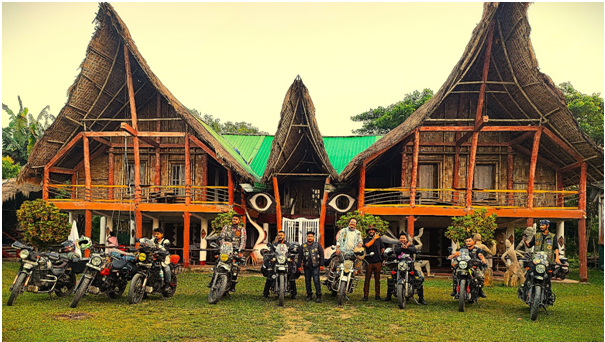
We took a picture together and said our goodbyes.
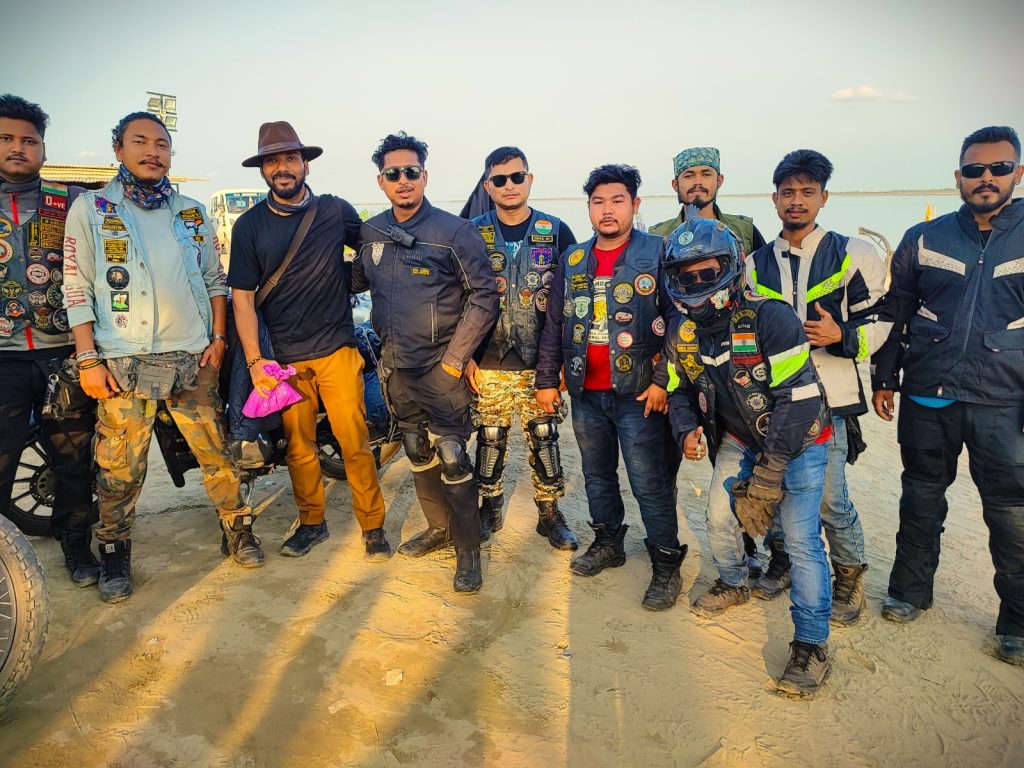
But just as I was about to leave, Manas asked, “How are you getting to town? It’s quite far from here.”
I didn’t have an answer.
There were a few auto-rickshaws nearby, so I said, “I’ll just take one.”
He nodded, then said, “We’re going the same way. Come with us—we’ll drop you. They’ll charge you double. Rehman added
I paused for a moment.
Then I said yes.
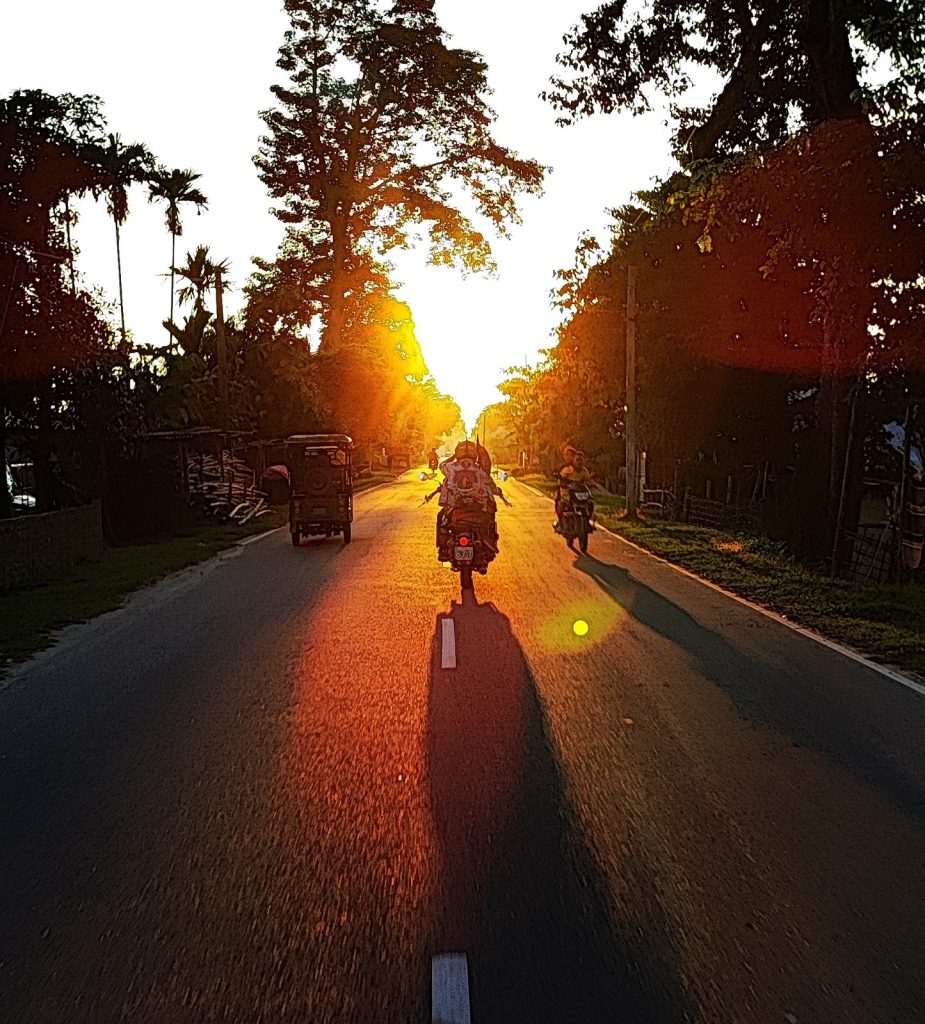
We rode toward the town at sunset—straight into the west. For a moment, it felt like we were riding into the sun itself, disappearing into its light.
Majuli opened up slowly as we rode through it. It’s a vast island in the middle of the Brahmaputra. I later learned that the island stretches nearly 80 kilometres in length and about 15 in width, one of the largest inhabited river islands in the world. And yet, it never feels crowded.
There’s a certain calm to it.
The whole place has a kind of island vibe—but not the kind most people imagine. No loud music, no parties, no crowds, no alcohol-driven chaos. Instead, there’s fresh water, open land, quiet villages, tribal traditions, and locally brewed rice beer.
The beauty of Majuli isn’t in anything flashy.
It’s in its simplicity.
We arrived at the centre of Majuli town. Beyond that, most of the island stretched out into either jungle or open crop fields.
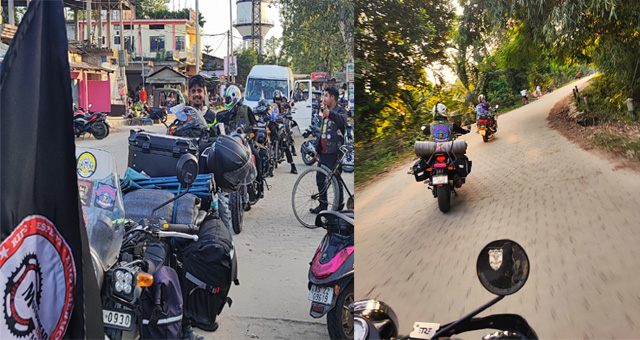
They asked for my hotel so they could drop me there.
I didn’t have one. I was still scrolling through options on my phone when, within minutes, they had already started making calls—discussing places in Assamese, figuring out something that would fit my budget.
Soon, we were riding again, this time toward a quieter part of the island. We stopped at a cottage in the middle of the forest near the river. In less than an hour, they had found me a place.
It was made entirely of bamboo—from the floor to the roof. Even the air carried its scent. Sleeping there felt like being inside the bamboo forest itself.
I wanted to thank them for everything, so I offered to buy beer for all of us. They looked at each other, speaking quickly in Assamese. For a moment, I thought I had said something wrong.
Then Manas asked, “Do you eat chicken cooked in banana flower?”
I told him I had eaten chicken, but never like that. In fact, I didn’t even know banana flower could be eaten.
He laughed and said I was missing out, that it was not only delicious but also full of nutrients.
That was enough to convince me.
Soon, we were buying groceries together.
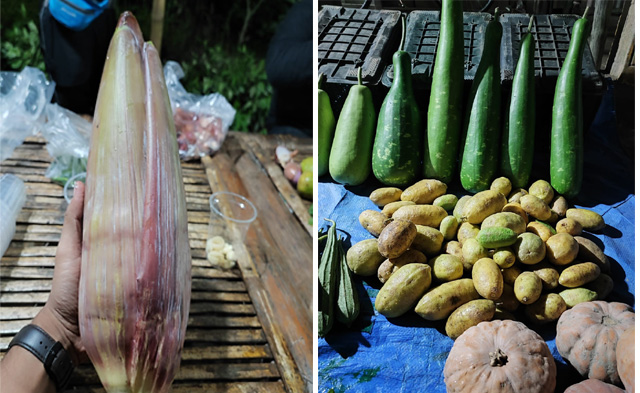
They spoke to the property owner and got permission to use the open kitchen of the cottage—also made entirely of bamboo. He agreed without hesitation.
Within an hour, they were cooking together like a team.
Everyone had a role. Someone chopping, someone cleaning, someone handling the fire.
It didn’t feel like effort.
It felt like something they had done many times before, which they had.
We sat around a long table—drinking beer, preparing dinner, talking, sharing stories about their bikes, engines, long rides, breakdowns, close calls. About when they started riding, how they met each other, how this whole thing came together.
Somewhere in between all of that, it stopped feeling like I had just met them that day.
I told them how impressed I was by how they rode in perfect formation, using hand signals, moving like a single unit. They were all properly geared up, following traffic rules, focused and disciplined.
Some of them carried walkie-talkies. It felt like they had trained for this. Like they had learned it some collage or somewhere. But what stood out most for me was, while riding, without speaking or honking, just by using hand gestures they communicated more than most people do with words.
Watching them ride wasn’t just about movement. almost like a kind of art on the road.
I learned that, Some of them had been riding for more than a decade. Some had built their lives around it, completely devoted to motorcycles.
For most of them, riding wasn’t just a part of life. It was their life.
And because of that, it had shaped everything—their personal lives, their careers, their choices.
Some were married. Some had kids. And still, they kept coming back to the road.
That’s what I couldn’t understand.
What was pulling them back again and again?
Because from what I could see, there wasn’t much money in it.
So what was it?
At some point during the night, I finally asked the question that had been sitting in my mind all along.
“Why do you guys keep riding like this? What makes you come back to the road again and again—even with all your responsibilities?”
There was a pause.
Then Deepak spoke. He was sitting next to me, quietly cutting banana flower.
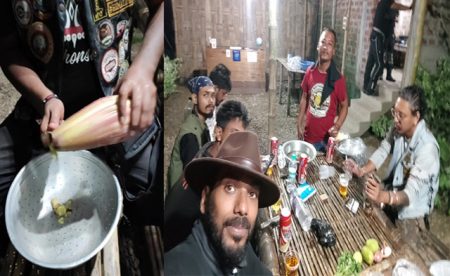
“Because out here,” he said, “it gives you a sense of belonging. It’s like having a second family—one you can count on.”
I turned to Manas.
“And you? Do you feel the same way?”
He nodded.
“Yes… it’s a family. One that supports you when you need it the most. And for me—it also gives me freedom from everything.”
I asked him what he meant.
Manas stood up, beer in his hand, walked around the table, and sat down next to me.
“You’re the first person to ask these questions,” he said.
He looked down for a moment.
“From the pain… from everything I carry.”
He told me about a serious accident he had when he was young. About the trauma that never really left him. About how life never fully went back to normal after that.
And then he said something simple.
“When I ride, it all goes quiet.”
After that, something shifted.
One by one, others started opening up.
Stories came out—things they probably don’t talk about often.
It felt like I had opened a gate, and everything just came pouring through.
At one point, Jaggu walked out of the kitchen and joined us.
“You know the best part?” he said. “We found each other because of bikes. Every ride, we test each other’s limits… and we get through it together. We’ve been through a lot, serious accidents, losing friends, and we’ve come out of it stronger, together.”
Iftakar raised his beer.
“It’s a trusted brotherhood—something you share stories and beer with.”
Everyone laughed.
“Cheers.”
That’s when I understood something about riders.
Every rider is searching for a balance.
Riding wasn’t just fun for them. It wasn’t about looking cool. It wasn’t about money.
It was something else.
When you ride a bike, there’s nothing between you and the world. No glass. No air conditioning. No music. No distractions. Just you, the machine, and the air hitting you again and again. At first, it feels like resistance, like something pushing against you.
And then, slowly, something changes.
You stop fighting it. You move with it. You become one with the bike, one with the air, and one with yourself and it starts to feel like you’re flying toward something and that something is freedom. Not the kind of freedom people talk about.
But freedom from expectations. From responsibilities. From society’s rules. From pain and from everything you carry inside. For a moment, it all disappears. It’s just you—moving forward, pushing through, pushing back against everything that once held you down.
And sometimes, on those long, unknown roads—you find others like you. People who understand without explanation. People carrying their own storms.
You find each other.
And when you ride together, it becomes more than just a journey.
It becomes something shared.
Something stronger.
A brotherhood.
I used to think riding was about looking cool. A way to clear your head.
Its way more than that.
Every rider is searching for something deeper.
The way you tune a bike, finding the perfect balance between throttle and engine,
in the same way, every ride becomes a search for balance between suffering and living.
And for a few fleeting moments,
you find it.
You feel it.
You are free.