

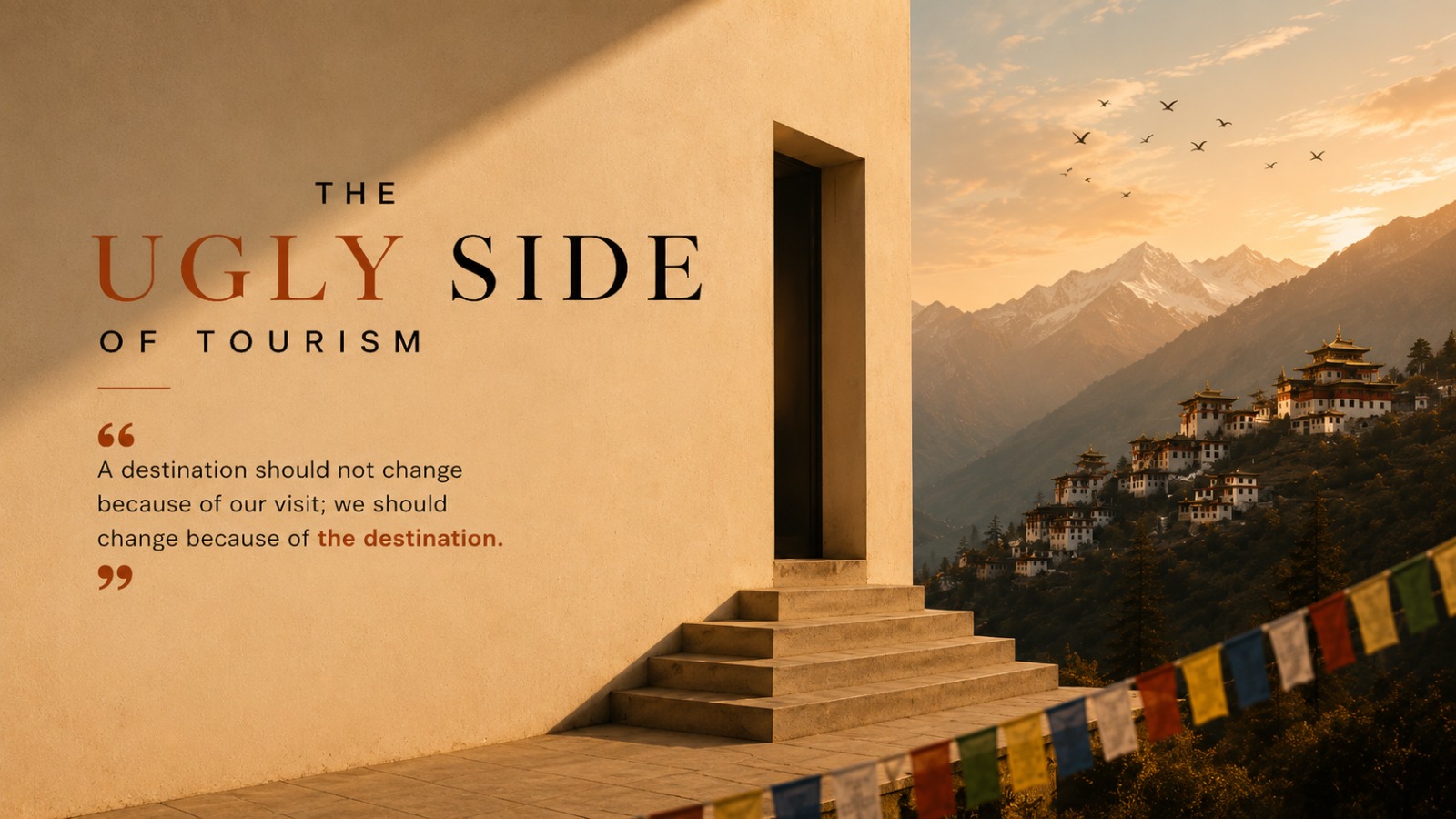
The ugly side of tourism is what happens when travel becomes consumption instead of connection.
When we think of tourism, we imagine escape—new places, good food, freedom and a break from routine. It is supposed to open us up to the world.
But there is another side to it. A quieter, less comfortable reality that doesn’t show up in photos.
The ugly side of tourism doesn’t appear suddenly—it builds slowly, through small actions repeated by many.
- Environmental Damage — Tourism often takes a heavy toll on natural ecosystems. Beaches get polluted, rivers fill with waste, and forests are cleared or disturbed to make space for roads, hotels, and other infrastructure.
As these habitats disappear, wildlife is left with fewer places to survive. Animals start wandering into nearby towns and villages in search of food and shelter, which creates conflict between people and nature.
Over time, places that were once known for their natural beauty slowly begin to lose their balance and charm.
- Overcrowding — Overcrowding is one of the biggest reasons a tourist destination begins to decline. As the visitor numbers rises, spaces become congested, and long queues at monuments, temples, and viewpoints become common. Popular landmarks become so packed that tourists cannot fully appreciate their beauty or take photographs without large crowds. As a result, the overall travel experience becomes less enjoyable and less memorable.
- Cultural Erosion — As a destination gains popularity, particularly through social media, many visitors arrive expecting to recreate the images and experiences they have already seen online. Over time, local culture, festivals, and everyday lifestyles begin to adapt to these expectations. Traditions that were once authentic and community-driven may be reshaped into performances designed primarily for tourists. As commercialization grows, the destination gradually loses its original character. Instead of evolving naturally from within the local community, its identity is increasingly influenced by visitor demand, leaving behind a carefully packaged version of the culture rather than its genuine essence.
- Exploitation of Local Communities — Tourism revenue does not always benefit local communities fairly. Large corporations often take the biggest share of profits, while locals are left with low-paying jobs and limited control over their own resources.
In some cases, this leads to exploitation of labour and disruption of local lifestyles. At the same time, natural resources—such as landscapes and water bodies—are often overused or polluted in the process.
- Rising Cost of Living — Tourism demand can drive up the cost of housing, food, and basic services. As areas turn into tourist hubs or short-term rental zones, prices rise beyond what many locals can afford.
It becomes a cycle – growth brings money, money raises prices, and affordability declines. In the end, it is often the lower and middle-income communities who feel the impact the most, struggling to afford the very places they call home.
- Loss of Authentic Experience – Ironically, tourism can undermine the very qualities that attract visitors in the first place. As destinations become increasingly commercialized, they gradually lose their uniqueness and begin to feel familiar and predictable, with the same international fast-food chains, beverage brands, and standardized entertainment found almost everywhere.
Local traditions, especially food, are often the first to change. Dishes that were once part of everyday life start getting replaced by fast food and standardized options, simply because they feel more familiar to visitors. And then, a few years later, the same local cuisine that once existed in every household returns—this time as a “must-try authentic experience” on a resort menu, carefully packaged and sold at a premium.
- Broken Trust & Scams – Trust also becomes fragile in many tourist destinations.
In some cases, visitors face overcharging, unclear pricing, or misleading services, whether from service providers or Some are offered deals at unusually low prices, only to be redirected to places where commissions are earned or worse, exploited, create a cycle of mistrust.
At same time, locals deal with unrealistic expectations, bargaining beyond reason, or insensitive behaviour.
Over time, both sides begin to expect the worst from each other. What could have been an exchange of culture becomes a negotiation of suspicion.
- The Price Tag on Faith – In some places, even faith has not remained untouched by the commercialization associated with tourism. Temples and other places of worship, once regarded as sanctuaries of peace and spiritual reflection, are increasingly shaped by commercial practices. You enter to find a donation box, you bow, only to find another staring you down, a pattern that follows you to the exit.
This can create the perception that spiritual experiences are tied to financial contribution rather than personal devotion. When darshan, blessings, and prasad are assigned fixed prices and priority access is reserved for those who can pay, a sacred experience risks being reduced to a commercial transaction.
We have created a system that implies God favours the wealthy, where exclusive darshan and blessings are reserved for VIPs in priority lines.
For many devotees, this shift diminishes the values of equality, humility, and inner peace that places of worship are meant to embody, leaving them to question whether faith itself has acquired a price tag.
- Disrespectful Behaviour – In some places, the problem isn’t just the crowd—it’s how people behave within it. Some tourists treat destinations like temporary spaces rather than living communities. Littering, damaging property, playing loud music, drinking irresponsibly, and ignoring local customs have become common in many places. In the rush to capture moments, making reels, having fun, and moving on basic civic sense is often overlooked.
Places that were once quiet and untouched now struggle with noise, waste, and constant pressure. This isn’t about how many people arrive, but how they choose to exist in that space.
Personal experience-
During a marathon in Tawang, I met a local MLA who was walking freely, without any entourage, speaking openly with people. What stood out was not her position, but her simplicity and involvement. Something I have never seen in other parts of India.
I mentioned how clean and vibrant the town felt, when the conversation shifted to litter in certain areas. She acknowledged that much of it came from tourists.
They were trying to create awareness, but couldn’t enforce strict rules because tourism was one of their main sources of income.
That moment stayed with me.
Places depend on tourists—but often suffer because of them
Final Thoughts-
Some people go somewhere new only to live the same life they left behind. Same food, same habits, same mindset—just in a different location. If everything remains the same, what’s the point of traveling?
You can get the same comfort, the same experience, even in your own city—with less time, less effort, and less money. You don’t have to deal with different values, cultures, or ways of living. There’s no need to adjust, no risk of misunderstanding, no need to follow someone else’s rules. In fact, you can book a resort on the outskirts of your city, eat the same food you’re used to, and even order anything you want online. Everything familiar, everything controlled—your version of a “perfect” vacation.
But the moment you step into a place that isn’t yours, that comfort can turn into friction. When people refuse to adapt, it often shows—in behaviour, in attitude, sometimes even in conflict. Small things escalate. Respect gets replaced by entitlement. And slowly, tolerance begins to wear thin.
And when that tolerance runs out, it doesn’t stay local—it spills over. Complaints, criticism, and “cancelling” begin on social media, shaping how the place is seen by others who have never even been there.
There are villages in Himachal where Indians aren’t allowed, while foreigners are welcomed. And the reason isn’t only money. There are many factors, but one of the biggest is simple respect for the place and for its people. And maybe that is where the real problem begins.
Conclusion-
Tourism is not the problem.
It never was.
The problem is how we choose to travel.
Travel fuels economies, but without responsibility, it can also fuel damage. If we want places to remain beautiful, we cannot treat them as something to consume. Respect, awareness, and responsibility matter just as much as our desire for enjoyment.
The truth is simple: a destination should not change because of our visit; we should change because of the destination.
If we return home without greater awareness, without deeper respect, without a better understanding of the world, then perhaps we never truly travelled at all.
Because every place we visit absorbs something from us—our behaviour, our mindset, our presence.
And over time, those small contributions define what the place becomes.
So the question is not whether we travel.
The question is—
what do we leave behind when we do?