




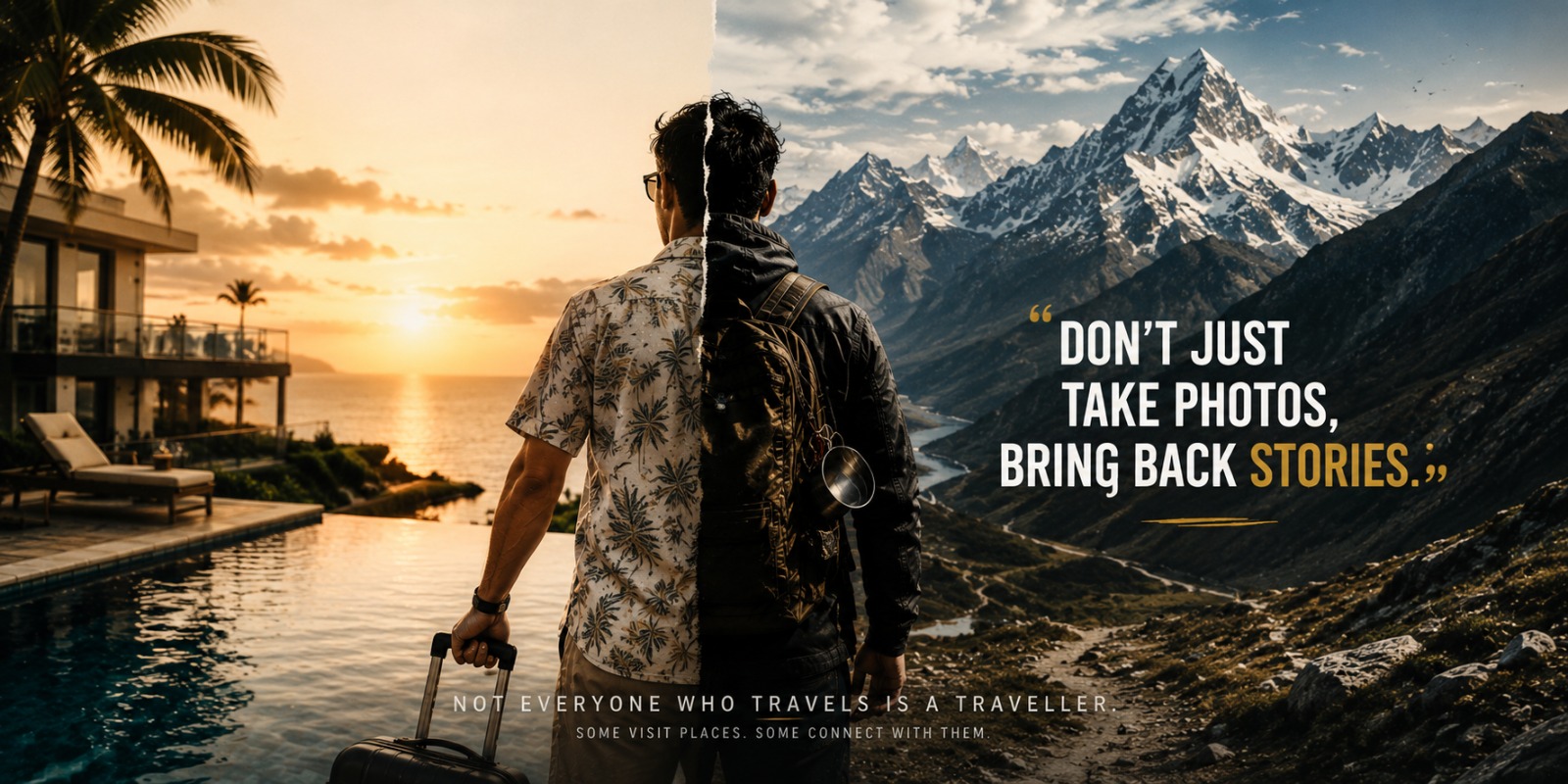
Not Everyone Who Travels Is a Traveller
Recently, my sister asked me something while packing her trolley for a trip to the mountains—”what is it like to travel without any plan or itinerary, just going somewhere new and exploring, figuring it out?”
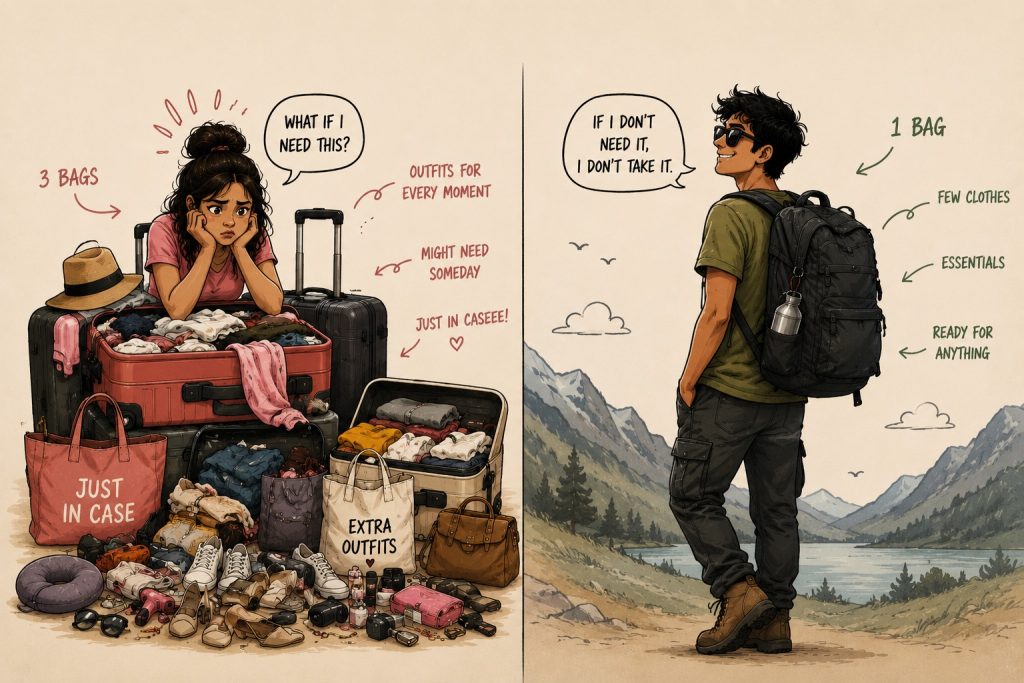
That’s when I realized how different we are when it comes to travelling. Everyone has their own needs and reasons. She likes everything planned—where she’ll stay, which places she’ll visit, what she’ll eat, even what she’ll wear on which day, with matching footwear and planned photoshoots. That’s dedication.
And then there’s me.
I just pack whatever clothes are clean at that moment and somehow fit into one duffle bag. One pair of running shoes and I stuff t-shirts or toiletries inside them, even in the socks. Basically, if there’s empty space, I don’t trust it.
Sounds stupid? Yeah, a little.
But in the mountains, every gram and space matters. You learn very quickly that overpacking is just a fancy way of punishing yourself. You use every bit of space you have just to carry what you need and not be the guy struggling halfway up.
It’s something I learned during my mountaineering course, and I still use it.

That made me think, “why do people travel so differently?”
After thinking about it, I realized something simple:
There are only two kinds of people when it comes to travel
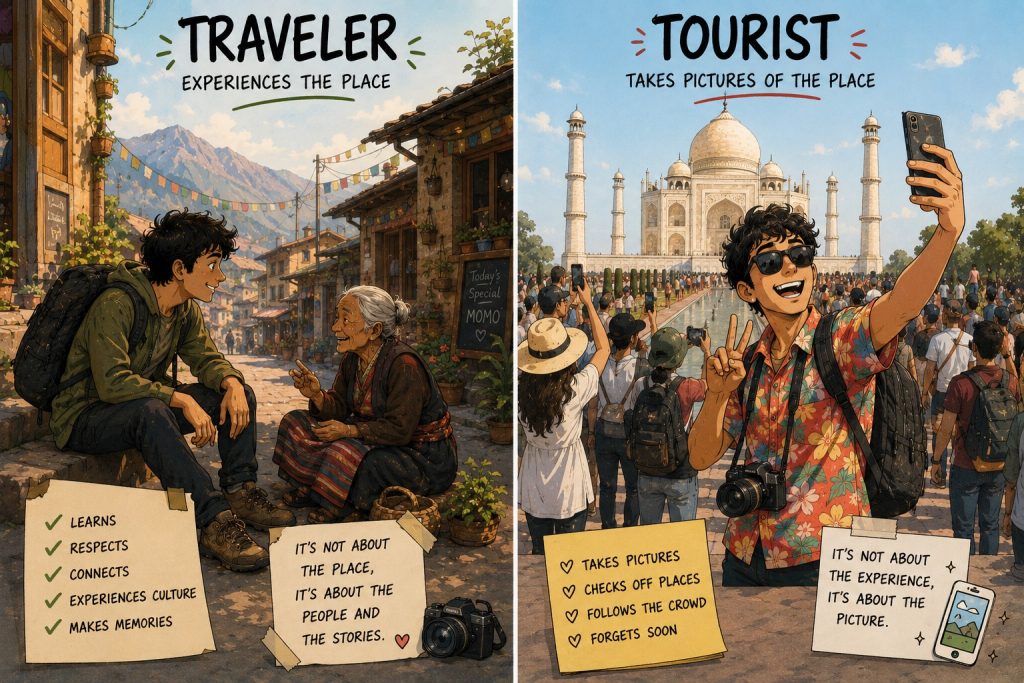
Travellers and Tourists
Traveller
A traveller moves to experience, not just to reach a place. He adapts, participates, and allows the journey to change him. He doesn’t just see a place—he becomes a part of it, even if briefly.
There are many kinds of travellers:
Wanderer
A wanderer moves without a fixed destination, guided by feeling.
He follows the road as it comes, stopping where it feels right.
His journey is about experience, not arrival.
Drifter
A drifter moves without direction or purpose.
He travels because he has nowhere to stay, often running from something.
His movement is more escape than intention.
Rambler
A rambler walks slowly, simply for the joy of being out there.
There is no urgency, just presence and ease.
The journey itself is enough.
Seeker
A seeker travels in search of meaning, clarity, or answers.
His journey is inward as much as outward.
He moves not for places, but for understanding.
Nomad
A nomad lives in constant movement, without a permanent home.
Travel is not a break for him, it is his way of life.
He moves for work, survival, or simply to keep going, often adapting to wherever he is.
Today, many follow this lifestyle through remote work, moving across countries while earning online. He doesn’t visit places; he lives between them.
Wayfarer
A wayfarer walks with purpose, even if the destination is unclear.
There is direction in his movement, guided by intention.
He travels toward something meaningful.
Flaneur
The word comes from 19th-century French culture.
A flaneur observes life, especially in cities, without rushing.
He watches people, moments, and details others miss.
His journey is about noticing, not reaching.
Tourist
A tourist moves for comfort, ease, and enjoyment. He observes more than he participates. The journey is about seeing, not becoming.
There are many kinds of tourists:
Pilgrim
A pilgrim travels for faith, devotion, or spiritual meaning.
The journey itself holds as much value as the destination.
He seeks connection, reflection, and inner peace.
Event Tourist
An event tourist travels for something specific—a match, a concert, a festival.
The place matters less than what is happening there.
The entire trip revolves around that one moment.
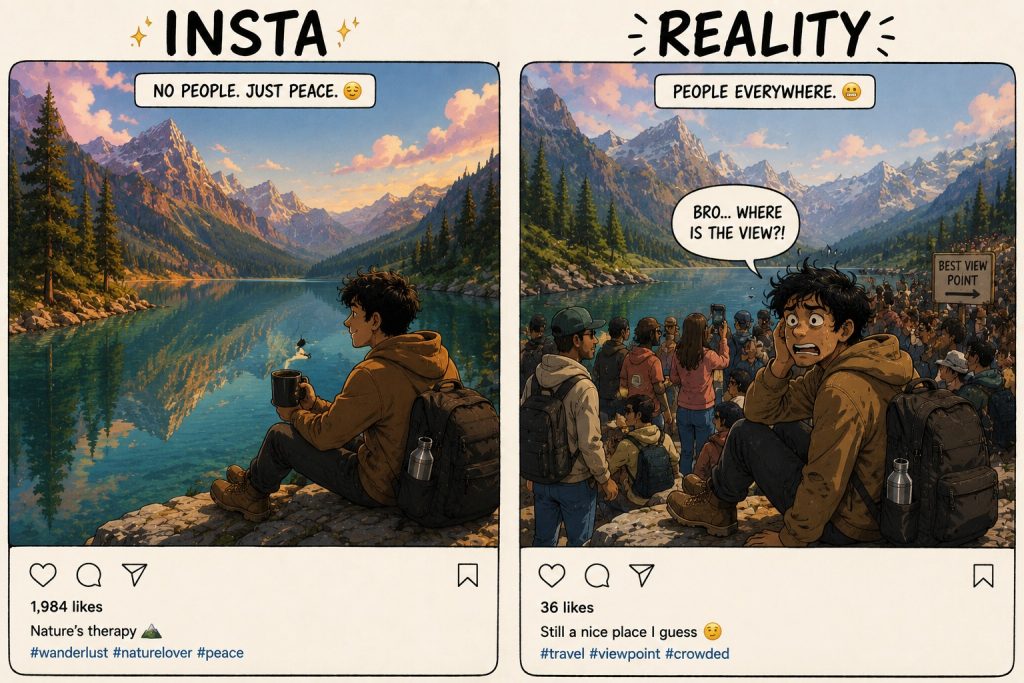
Reelchaser
A reelchaser travels to recreate what they saw online.
The journey is measured in photos and videos, not moments.
He follows trends, not curiosity.
Sightseer
A sightseer visits famous places and main attractions.
He focuses on seeing and capturing moments.
Travel becomes a checklist of places visited.
Leisure Tourist
A leisure tourist travels for comfort and relaxation.
They stay in good resorts, eat familiar food, and focus on enjoying the moment without stress.
Exploration takes a backseat to ease and convenience.
For them, travel is not about discovery, but about taking a break from routine.
Package Tourist
A package tourist follows a fixed itinerary.
Everything is planned—stay, food, and activities.
Convenience and predictability come first.
Souvenir Tourist
A souvenir tourist focuses on buying things.
Travel becomes collecting objects rather than experiences.
The place is remembered through items, not moments.
And then there are those who go somewhere new but refuse to change anything about themselves.
Weekend Tourist
Then there’s the weekend tourist—the kind you’ll find escaping the city every Friday night.
They’re often called party tourists. They don’t come to understand a place, they come to use it. Same habits, different location. Same music, same drinking, same routine—just with a mountain or beach in the background.
They consume places without giving anything back. Loud, careless, and temporary. Like a leech that shows up, takes what it wants, and disappears before anything real begins.
This is common among corporate workers and young crowds looking for a quick escape. And there’s nothing wrong with taking a break—but when the place becomes just a backdrop for your weekend, something is lost.
So what is travel?
Maybe it’s simple.
Travel is not about where you go.
It’s about how you show up when you get there.
One person returns with pictures.
Another returns with perspective.
And what did I tell my sister?
I told her this—
“You don’t have to travel like me.
But if you’re going somewhere new, don’t carry your whole life with you. Leave your routine, your comfort, and your expectations behind for a while. Do whatever excites you—have an experience, make a memory, and come back with a story your family will remember long after the trip is over.”
“Because, to me, what’s the point?
If you want the same food, the same people, and the same life, you can stay in your own city.
But if you choose to go somewhere different, be ready to be uncomfortable. Learn, listen, and let the place be what it is.
Let it change you even little.
Because if you come back unchanged, it was just an expensive photoshoot.
Instead, come back with something real—a story, a memory, or a part of you that didn’t exist before.
Sometimes, the best part of travel is the part you never planned at all.”